

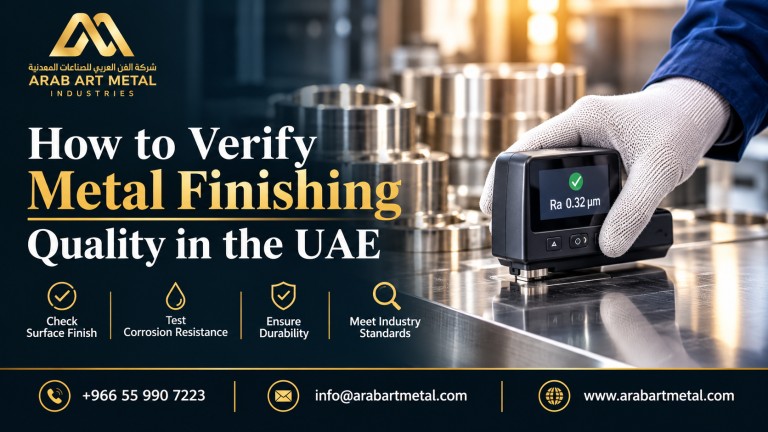
How to Verify Metal Finishing Quality in the UAE
You send parts out for plating, and they come back shiny. But shiny is not the same as sound. In the UAE, heat, humidity and coastal salt can expose a weak finish within months. Before you accept a batch from any provider of metal finishing services in UAE, it pays to know what to check and what to ask for.
Start with a Clear Specification
You can only test against something written down. Note the base metal, the finish type, the thickness range, the appearance you expect and the environment the part will live in. Ask your supplier to confirm all of this on the quote or job card. Without a spec, “good quality” is just an opinion.
Check the Appearance First
Look at the part under even, bright light. The finish should be uniform in colour and gloss, with no pits, blisters, burn marks, rough patches or bare spots. Pay extra attention to edges, threads, holes and recesses, where plating tends to thin out or build up. If possible, compare the batch against an approved sample agreed before production.
Measure Coating Thickness
Thickness decides how long a finish lasts. Too thin and it wears or corrodes early. Too thick and it can affect fit or make the coating brittle. Suppliers usually measure it without damaging the part, using X-ray fluorescence (XRF) or magnetic and eddy-current gauges. Ask for readings at several points, especially on critical surfaces, and compare them with your spec.
Test Adhesion
A coating that looks perfect but peels is still a failure. Simple checks include a tape test, a bend test on a sample piece, or a scratch test. Any lifting, flaking or blistering usually points to poor cleaning or pre-treatment before plating. That is why surface preparation matters as much as the plating itself, as we explain in our guide to surface preparation and quality control.
Use Salt Spray Testing for Corrosion Resistance
For UAE conditions, corrosion resistance is the test that matters most. In a salt spray test, sample parts sit in a closed chamber filled with salt mist for a set number of hours, and the lab records when corrosion appears. The method is set out in the ASTM B117 standard. Keep in mind that it compares finishes under controlled conditions and does not promise an exact number of years in service. It is still a useful way to choose between finishes for coastal or outdoor projects, and it pairs well with a proper corrosion resistant coating.
Ask for Documentation
A reliable supplier should be able to show thickness readings, test results and batch or job numbers, with photos where helpful. Keep these records, because they make it much easier to trace the cause if a problem appears later. Also ask whether the tested samples came from the same batch as your parts, rather than a separate trial piece.
Red Flags When Comparing Suppliers
When you compare metal finishing services in UAE, be careful if a supplier:
- gives vague answers about thickness or standards
- cannot show any inspection or test results
- quotes a very low price without asking for a specification
- is reluctant to rework parts that fail
Final Thoughts
Verifying finish quality does not need a laboratory of your own. A clear spec, a careful visual check, thickness readings, an adhesion test and, where needed, salt spray results will tell you most of what you need to know.
At Arab Art Metals, we plate and finish parts with strict quality inspection and are happy to explain how each job is checked. If you need reliable metal finishing services in UAE, contact us with your drawings, base metal and finish requirements, or call +966 55 990 7223 or email info@arabartmetal.com. Our team will recommend the right finish and the right checks for your parts.
Frequently Asked Questions
1. Can I check metal finishing quality without a lab?
Yes, to a point. You can inspect the appearance, run a simple tape or bend test on a sample, and ask your supplier for thickness readings. For corrosion performance, a lab salt spray test is the reliable option.
2. What is a salt spray test?
It is a corrosion test where sample parts are placed in a chamber with a fine salt mist for a set number of hours. The result shows how long the finish resists rust or corrosion under those controlled conditions.
3. How thick should plating be?
It depends on the base metal, the finish and where the part will be used. Decorative items need a thinner layer than parts facing wear or harsh conditions, so always follow your written specification.
4. How long does a salt spray test take?
Test length is set by the specification and can range from a few hours to several hundred hours or more. Your supplier or lab can recommend a duration based on how the part will be used.
5. What should a finishing quality report include?
At a minimum: the job or batch number, the finish and base metal, thickness readings, the results of any adhesion or corrosion tests, and the inspection date.
