

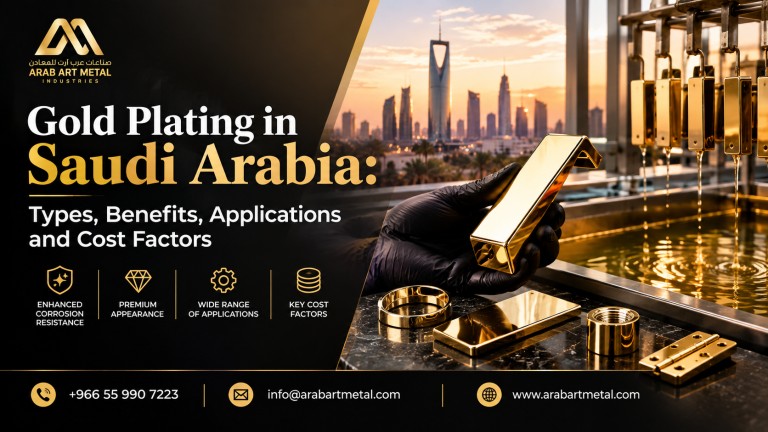
Gold Plating in Saudi Arabia: Types, Benefits, Applications and Cost Factors
Updated September 2026 · 10 min read · arabartmetal.com
Gold has a special place in the Kingdom. It shows up at weddings and Eid, in majlis décor, in the trophies handed out at corporate galas, and inside the electronics that keep industry running. Solid gold, though, is rarely practical for anything larger than a ring. That’s why gold plating in Saudi Arabia has become the go-to way to get the look, the corrosion resistance and the conductivity of gold at a fraction of the cost.
At Arab Art Metal Industries, we’ve provided electroplating and metal finishing from our facility in Al Sulay, Riyadh since 2017. Clients usually come to us with the same questions: Which type of gold plating do I need? How thick should it be? Why do two quotes for the “same” job look so different? This guide answers all three.
What Is Gold Plating?
Gold plating is the process of depositing a thin, even layer of gold onto the surface of another material, usually a metal such as brass, copper, steel, silver or nickel. The most common method is electroplating: the part is immersed in a gold solution and an electric current draws gold ions onto its surface, building up a layer measured in microns (thousandths of a millimetre).
The result looks and behaves like gold on the surface, while the core stays strong, light and affordable. Done properly, it’s far more than a cosmetic coat of paint. It’s a bonded metal layer with real functional properties.
Gold is rarely plated directly onto the base metal. Most quality jobs follow a sequence:
- Cleaning and degreasing to remove oils, polishing compounds and oxides.
- Activation in a mild acid so the surface accepts the next layer.
- Nickel underplate, which acts as a barrier so copper or zinc in the base metal can’t migrate into the gold and dull it over time. It also adds hardness and levelling.
- Gold strike, a very thin initial layer that promotes adhesion.
- Gold plating to the specified thickness and colour.
- Rinsing, drying and optional lacquer for decorative pieces that will be handled often.
- Inspection, including thickness checks, adhesion tests and visual QC.
Skipping steps, especially cleaning and the underplate, is the main reason cheap gold plating peels or discolours within months.
Types of Gold Plating
Not all gold plating is the same. The type you choose depends on whether the part is decorative, functional or both.
Flash Gold Plating (Gold Wash)
An extremely thin gold layer, typically well under a quarter of a micron. It gives an attractive gold colour at the lowest cost, but wears through quickly with handling or friction. It suits display items, packaging hardware and pieces that won’t be touched often.
Decorative Heavy Gold Plating
A thicker layer, often 1 micron or more, used for jewellery, trophies, gifts, pens, watch parts and interior fittings that are handled regularly. It lasts much longer than flash plating and can be produced in different karats and tones, from bright 24K yellow to softer 18K shades.
Hard Gold Plating
Gold alloyed with a small amount of cobalt or nickel to increase hardness and wear resistance. It’s the standard for electrical connectors, switch contacts, edge fingers on circuit boards and any part that is plugged, unplugged or rubbed repeatedly.
Soft Gold Plating (High-Purity Gold)
Very pure gold (typically 99.9%) with no hardeners. It’s softer, but ideal for wire bonding, soldering and high-reliability electronics, as well as medical and aerospace components where purity matters.
Rose Gold and Coloured Gold Plating
Gold alloyed with copper (for rose and pink tones) or other metals to shift the colour. Popular for fashion jewellery, watches, gifts and contemporary interior fittings. Colour consistency across batches depends heavily on bath control, so ask your plater how they manage it.
Gold Vermeil
A specific term for gold over sterling silver. Under the US Federal Trade Commission’s jewellery guides, vermeil requires gold of at least 10 karat and a minimum of 2.5 microns over sterling silver. Although it’s a US rule, many international jewellery brands use it as a benchmark, so it’s useful to know if you export or sell to global buyers.
Selective and Brush Plating
Instead of plating the whole part, gold is applied only to specific areas, such as contact points, logos or edges, using masking or a brush-plating tool. This saves gold and cost on large parts, and it allows on-site touch-ups for fixed architectural elements.
Quick Comparison: Which Gold Plating Type Do You Need?
| Type | Typical thickness | Main strength | Best for | Relative cost |
|---|---|---|---|---|
| Flash gold | Under 0.25 µm | Colour at lowest cost | Display items, light-use décor | Low |
| Decorative heavy gold | 1 µm and above | Looks rich, lasts with handling | Jewellery, trophies, gifts, fittings | Medium |
| Hard gold | 0.5–2.5 µm+ | Wear resistance | Connectors, contacts, switches | Medium to high |
| Soft (pure) gold | 0.5–2.5 µm+ | Purity, bondability | Electronics, medical, aerospace | Medium to high |
| Rose / coloured gold | 0.5 µm and above | Fashionable tones | Jewellery, watches, interiors | Medium |
| Vermeil | 2.5 µm minimum | Premium jewellery standard | Silver jewellery | High |
| Selective / brush | Varies | Precision, less gold used | Large parts, on-site repairs | Varies |
Understanding Gold Plating Thickness
Thickness is the single biggest factor in how long gold plating lasts and how much it costs. It’s measured in microns (µm).
For engineering applications, the widely used ASTM B488 standard groups gold coatings into thickness classes, from Class 00 (around 0.1–0.25 µm) up to Class 3 (over 2.5 µm), alongside types based on gold purity and codes for hardness. Specifying a class and type on your drawing removes guesswork and makes quotes easier to compare.
As a practical rule of thumb:
- Under 0.25 µm: colour only; suitable for items that are rarely touched.
- 0.5–1 µm: light everyday handling, such as trophies, décor and gifts.
- 1–2.5 µm: jewellery, pens, watch parts and frequently handled fittings.
- 2.5 µm and above: premium jewellery, high-wear connectors and high-reliability parts.
Want to know how thickness translates into years of use? Read our detailed guide, How Long Does Gold Electroplating Last?
Key Benefits of Gold Plating
- Corrosion and tarnish resistance. Gold doesn’t oxidise, so a sound gold layer protects the surface underneath. This matters in Saudi Arabia’s heat, dust and coastal humidity.
- Excellent electrical conductivity. Gold keeps a low, stable contact resistance, which is why it’s used on connectors and contacts in critical electronics.
- Premium appearance at lower cost. You get the colour and prestige of gold without the price and weight of solid gold.
- Hypoallergenic surface. High-purity gold is gentle on skin, although the underplate and base metal still matter for people with nickel sensitivity.
- Solderability and bondability. Soft gold makes a reliable surface for soldering and wire bonding.
- Heat and infrared reflectivity. Gold reflects infrared well, which is useful in some aerospace and thermal-management components.
- Restoration value. Worn or tarnished antique pieces, heirlooms and fittings can be stripped and re-plated to look new.
Applications of Gold Plating in Saudi Arabia
Jewellery and Accessories
Gold carries deep cultural weight in the Kingdom. According to the World Gold Council, as reported by Arab News, Saudi gold jewellery demand rose around 35% year on year in the first quarter of 2025, even as gold prices climbed past US$3,500 an ounce that April. With solid gold that expensive, gold-plated silver, brass and stainless steel jewellery gives brands and retailers a way to offer the look at accessible prices. For trends in this space, see top trends in jewellery electroplating.
Trophies, Awards and Medals
A gold finish instantly signals “first place.” Metal trophies, medals, plaques and commemorative pieces are commonly gold plated for corporate awards, government ceremonies, schools and sports events. We produce and finish these in-house as part of our awards and trophies service.
Corporate Gifts and Branded Merchandise
Gold-plated pens, keychains, cufflinks, coins, desk pieces and logo badges make premium gifts for clients, partners and VIP guests. Explore our custom merchandise range for ideas.
Luxury Interiors and Architectural Fittings
Hotels, palaces, majlis spaces, villas and retail showrooms across the Kingdom use gold-plated door handles, taps, light fittings, railings, décor panels and furniture trim. For large or fixed items, this often combines with other finishes from our architectural metal finishes service.
Electronics, Connectors and Industrial Components
Gold’s conductivity and corrosion resistance make it the finish of choice for connectors, relay and switch contacts, circuit board edge fingers and sensor components. These applications usually call for hard or high-purity gold plated to a defined standard. See also benefits of electroplating for industrial applications.
Automotive, Aerospace and Medical
Badges, emblems and trim pieces in the automotive sector; reflective and conductive parts in aerospace; and specialist instruments and components in medical and dental work all use gold plating where performance or appearance demands it.
Restoration and Heritage Pieces
Antique lamps, religious and calligraphy décor, vintage cutlery and heirloom items can be stripped, repaired and re-plated. Combined with antique metal finishes, this can restore character without losing the original design.
What Affects the Cost of Gold Plating in Saudi Arabia?
Gold plating is priced per job, not per gram of gold alone. That’s why a simple comparison of two quotes can be misleading. These are the factors that actually move the price:
- Gold price. The international gold price directly affects the cost of plating solutions and anodes. When prices spike, heavy plating jobs feel it most.
- Thickness. Doubling the thickness roughly doubles the gold used and increases plating time. This is usually the largest single cost lever.
- Karat and colour. 24K, 18K-tone, rose gold and custom colours use different solutions and controls. Matching a specific colour across batches takes extra care.
- Surface area and part geometry. Large parts need more gold. Complex shapes with deep recesses or sharp edges need careful racking and sometimes auxiliary anodes to plate evenly.
- Base material and condition. Brass and copper plate easily. Stainless steel, aluminium, zinc die-cast and old, corroded or previously plated items need extra preparation, stripping or special strikes.
- Surface preparation and polishing. Plating shows every scratch. Pieces that need grinding, polishing or buffing before plating cost more, and this step often decides the final look.
- Underplating. A proper nickel or other barrier layer adds cost but greatly improves durability. Skipping it is a false economy.
- Quantity and batch size. Setup, racking and bath preparation are spread across the batch. A single piece costs far more per unit than a run of 500.
- Masking and selective plating. Plating only certain areas saves gold but adds labour.
- Finishing and protection. Lacquer coats, anti-tarnish treatments, brushed or matte effects and protective packaging all add to the price.
- Testing and certification. Thickness measurement, adhesion tests and documentation for engineering or export customers add time and cost, but give you proof of what you paid for.
- Turnaround time. Rush jobs that jump the queue or need overtime typically cost more.
How to Get an Accurate Gold Plating Quote
To get a fast, comparable quote, send your plater:
- Photos or drawings of the part, with dimensions
- The base material (if known)
- Quantity
- Desired colour and karat
- Required thickness or use case (display, daily handling, electrical contact)
- Whether masking, polishing or lacquer is needed
- Your deadline and delivery location
With this information, our team can recommend the right specification rather than defaulting to the thinnest possible layer.
Gold Electroplating vs PVD Gold Finish
You’ll often see “PVD gold” offered as an alternative. Physical vapour deposition (PVD) applies a hard, thin ceramic coating, often titanium nitride or a similar compound, in a vacuum chamber to produce a gold colour. It’s extremely scratch-resistant and popular on watches, taps and stainless steel fittings.
The key difference is that most PVD “gold” finishes contain little or no actual gold, while electroplating deposits real gold. Choose electroplating when you need genuine gold for its value, colour depth, conductivity or solderability. Consider PVD when you need a gold-coloured finish with maximum scratch resistance on stainless steel and don’t need real gold.
How to Choose a Gold Plating Company in Saudi Arabia
- Ask what thickness they’re quoting. A price without a micron figure isn’t a real quote.
- Ask about surface prep and underplating. These determine whether the gold stays put.
- Check how they measure thickness and adhesion. Reputable platers test and can share results.
- Look at past work. Browse our completed projects to see the finishes we deliver.
- Check the full range of finishes. A company that also offers silver, nickel, copper and bronze electroplating can recommend the best finish for your budget, not just the one they sell.
- Consider location and logistics. A plater based in Riyadh can reduce transport time and risk for Saudi clients. We also support clients across the GCC through our electroplating services in Riyadh
Get Expert Gold Plating in Riyadh
Arab Art Metal Industries provides gold electroplating for jewellery, trophies, corporate gifts, architectural fittings and industrial components from our Riyadh facility, with in-house surface preparation, underplating and quality checks. Explore our full range of electroplating services, or contact our team with photos and quantities for a tailored quote.
📍 Khuraisa, Al Sulay, Riyadh | ✉️ info@arabartmetal.com | 📞 +966 55 990 7223
Frequently Asked Questions
1. How much does gold plating cost in Saudi Arabia?
There’s no single price, because cost depends on thickness, surface area, karat and colour, base material, surface preparation, quantity and the current gold price. Send photos, dimensions, quantity and your intended use to get an accurate quote.
2. How long does gold plating last?
It depends mostly on thickness and use. Flash plating on a frequently handled item may wear in months, while a properly prepared layer of 1–2.5 microns or more can last years. Our guide on how long gold electroplating lasts covers this in detail.
3. What is the difference between hard gold and soft gold plating?
Hard gold contains small amounts of cobalt or nickel to improve wear resistance and is used for connectors and contacts. Soft gold is high-purity gold without hardeners and is preferred for wire bonding, soldering and high-reliability electronics.
4. What thickness of gold plating is best?
For display items, under 0.25 microns can be enough. Trophies and décor typically use 0.5–1 micron, jewellery and frequently handled items 1–2.5 microns, and premium jewellery or high-wear parts 2.5 microns or more.
5. Can any metal be gold plated?
Most metals can, including brass, copper, silver, nickel and steel. Stainless steel, aluminium and zinc die-cast parts need special preparation or strike layers to ensure good adhesion.
6. Is gold plating real gold?
Yes. Electroplating deposits a genuine layer of gold onto the base material. The amount of gold is small compared to solid gold, which is why plating is far more affordable.
7. Is PVD gold better than gold electroplating?
They suit different needs. PVD gives a very scratch-resistant gold-coloured finish but usually contains little or no real gold. Electroplating provides genuine gold with better colour depth, conductivity and solderability.
8. How do I care for gold-plated items?
Wipe with a soft dry cloth, avoid perfumes and harsh chemicals, clean with mild soapy water only, and store pieces separately to avoid scratches.
