

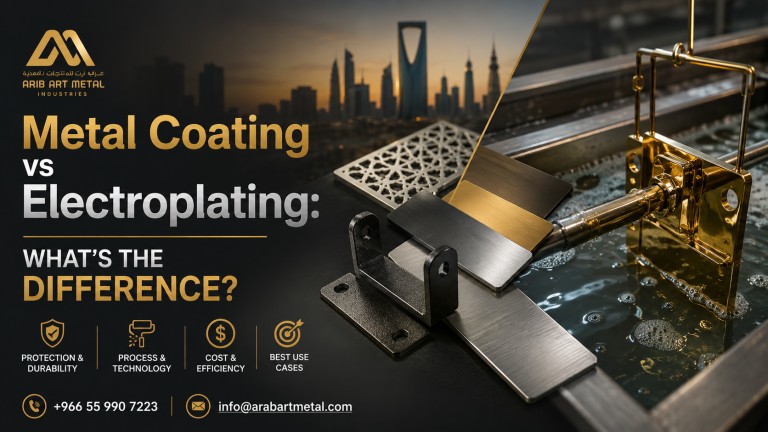
Metal Coating vs Electroplating What’s the Difference?
Updated August 2026 · 10 min read · arabartmetal.com
If you’ve been quoting a finishing job — a batch of trophies, a set of architectural railings, an automotive trim piece — you’ve probably heard “coating” and “electroplating” used almost interchangeably. But they’re not the same thing. Picking the wrong one can mean paying for a finish that either doesn’t hold up to the environment it’s going into, or costs more than the project needs.
Here’s the distinction in plain terms: electroplating is one specific method of applying a metal coating, using an electric current to bond metal ions onto a surface. Metal coating, on the other hand, is the broader category. It includes electroplating alongside several other techniques — powder coating, PVD, anodising, and more — that don’t rely on electricity at all. So, every electroplated part is coated, but not every coated part is electroplated.
What Is Electroplating?
Electroplating is an electrochemical process. First, the object to be plated is submerged in a solution containing dissolved metal ions — say, gold, nickel, silver, or bronze — and connected to an electrical circuit. Then, when current runs through the solution, the metal ions migrate to the object’s surface and bond to it as a thin, even metallic layer.
Because the process is driven by electricity moving through a conductive solution, electroplating only works on conductive substrates, or substrates that have been pre-treated to conduct electricity. The coating thickness is measured in microns — often just a few microns thick, though it can be built up further depending on the application. That thinness is exactly why electroplating is prized for detailed, decorative work: it captures fine surface detail without adding bulk. This is part of why it’s the standard finish for jewelry, trophies, medals, and decorative architectural components.
What Is Metal Coating (In the Broader Sense)?
“Metal coating” is the umbrella term for any process that applies a protective or decorative layer to a metal, or sometimes non-metal, surface. That includes:
- Electroplating — electrochemical deposition of a metal layer (gold, silver, nickel, copper, bronze)
- Powder coating — dry powder applied electrostatically, then cured under heat into a hard, thick finish
- PVD (Physical Vapor Deposition) — metal vaporized in a vacuum chamber and deposited as an ultra-thin, highly durable film
- Anodizing — an electrochemical process specific to aluminum that thickens and hardens its natural oxide layer
- Galvanizing — coating steel with a protective layer of zinc, typically by hot-dipping
- Spray/liquid coating — conventional wet paint or protective liquid coatings applied by spray gun
So when someone asks for “a metal coating,” the real question is which of these processes actually fits the job. That’s where electroplating either is or isn’t the right answer.
Metal Coating vs Electroplating: Side-by-Side Comparison
| Factor | Electroplating | Metal Coating (Non-Electro Methods) |
|---|---|---|
| Process | Electrochemical deposition using electric current | Varies — thermal spray, powder curing, vapor deposition, dipping |
| Typical thickness | A few microns (thin, precise) | Ranges from microns (PVD) to much thicker layers (powder coating, galvanizing) |
| Best for | Decorative detail, jewelry, trophies, connectors, fine architectural finishes | Heavy-duty protection, large surfaces, industrial/outdoor components |
| Substrate requirement | Must be electrically conductive | Works on conductive and non-conductive surfaces depending on method |
| Corrosion resistance | Good, especially with nickel/chrome undercoats | Often superior for harsh environments (galvanizing, powder coating) |
| Finish appearance | High-gloss, mirror, or metallic sheen | Ranges from matte to glossy depending on method |
| Relative cost | Cost-effective for detailed, small-scale work | Cost varies widely by method and coverage area |
Where Electroplating Wins
Electroplating is the right call when the job needs precision, a true metallic finish, or a specific decorative metal like gold or silver. For example:
- Awards, trophies, and medals — gold and silver electroplating give that authentic metallic shine without the weight or cost of solid precious metal.
- Automotive trim and emblems — chrome and nickel electroplating deliver the reflective finish buyers expect on grilles, badges, and interior accents.
- Electronic connectors — gold and nickel plating provide the conductivity and oxidation resistance electronics manufacturers depend on.
- Architectural and interior decorative elements — staircase railings, door hardware, and fixtures where a mirror or antique metal finish matters as much as durability.
Where Broader Metal Coating Methods Win
Other coating methods tend to pull ahead when the priority shifts from appearance to raw protection or coverage of large, structural surfaces:
- Outdoor structural steel and fencing — galvanizing or industrial powder coating handles long-term weather exposure better than a thin decorative plate.
- Heavy machinery and industrial equipment — thicker protective coatings resist abrasion and impact in ways a few microns of plating can’t.
- Large architectural facades — coverage area and cost efficiency often favour spray or powder application over electroplating tanks.
- Parts needing extreme wear resistance — PVD coatings, in particular, are used where hardness and low friction matter more than decorative shine.
Durability and Corrosion Resistance
This is the question that actually decides most quoting conversations: which finish will last? Electroplated layers are thin, but they can still be highly durable when the right base metal, plating thickness, and surface prep are used. For example, nickel undercoats beneath gold or chrome add real corrosion resistance rather than relying on the decorative top layer alone. That said, because the layer is thin, it’s more vulnerable to scratching through to the substrate than a thicker powder coat or galvanised layer would be.
For components facing constant outdoor exposure, chemical contact, or heavy mechanical wear, thicker non-electro coatings generally outperform plating on raw longevity. But for components where appearance, precise detail, and a genuine metallic look matter as much as protection, electroplating remains the better trade-off.
How to Choose the Right Finish for Your Project
A few questions worth asking before specifying a finish:
- What’s the end use? Decorative and detail-focused work, like jewelry, awards, or trim, leans electroplating. Structural and exposure-heavy work, like fencing, machinery, or facades, leans toward broader coating methods.
- What’s the substrate? Electroplating needs a conductive surface, while some coating methods work on materials plating can’t touch.
- What environment will it face? Constant outdoor exposure, chemical contact, or heavy abrasion generally calls for a thicker protective coating.
- Does the metal itself matter visually? If the brief specifically calls for gold, silver, bronze, or chrome appearance, electroplating is usually the direct route to that look.
- What’s the production scale? Electroplating is efficient for batches of smaller items, while large-surface jobs often favor coating methods designed for coverage.
If any of these answers aren’t obvious from the brief, that’s exactly the conversation worth having with a finishing specialist before committing to a process.
FAQ: Metal Coating vs Electroplating
1. Is electroplating the same as coating?
Electroplating is a type of metal coating, but not all metal coating is electroplating. Specifically, electroplating uses an electric current to deposit metal ions onto a conductive surface, while “coating” also covers other methods, like powder coating, PVD, and galvanizing.
2. What are the disadvantages of electroplating?
The main drawbacks are that it requires a conductive substrate, and the layer is relatively thin, so it can wear through with heavy abrasion. It’s also less cost-effective for very large surfaces compared to bulk coating methods.
3. What is the difference between coating and plating?
“Plating” almost always refers to electroplating or similar electrochemical/electroless metal deposition. “Coating,” on the other hand, is the broader term covering any protective or decorative layer, applied by electrical, thermal, or mechanical means.
4. Which is better, electroplating or powder coating?
Neither is universally better. Electroplating suits detailed, decorative, small-scale work with a true metallic finish, while powder coating suits larger surfaces and harsher environments where thickness and abrasion resistance matter more.
5. How long does electroplating last?
With proper surface preparation and an appropriate undercoat, such as nickel beneath gold or chrome, a quality electroplated finish can last for years under normal use. That said, heavy abrasion or harsh chemical exposure will wear it faster than a thicker coating would.
6. What metals can be electroplated?
Gold, silver, copper, nickel, bronze, and chromium are among the most common metals used in electroplating. Each is chosen for a mix of appearance, conductivity, and corrosion resistance.
7. Is electroplating more expensive than coating?
It depends on the job. For small, detailed items, electroplating is often cost-effective. But for large surfaces or structural components, other coating methods are usually more economical per unit area.
8. What is the strongest type of metal coating?
For raw hardness and wear resistance, PVD and certain powder coatings tend to outperform standard electroplating. That said, “strongest” ultimately depends on the specific environment and stress the finish needs to withstand.
Final Thoughts
Metal coating and electroplating aren’t competing options so much as two different tools for two different jobs. Electroplating is your answer when the finish needs to look and behave like a true metal surface — gold, silver, chrome, bronze — on detailed or smaller-scale work. Broader coating methods, meanwhile, take over when the priority is coverage, thickness, and standing up to years of outdoor or industrial punishment.
At Arab Art Metal, we work in both worlds — from precision gold, silver, and nickel electroplating for trophies, medals, and decorative pieces, through to industrial metal coating and corrosion-resistant coating for architectural and industrial components. If you’re not sure which process your project actually needs, contact us and we’ll walk you through it before you commit to a finish.
