

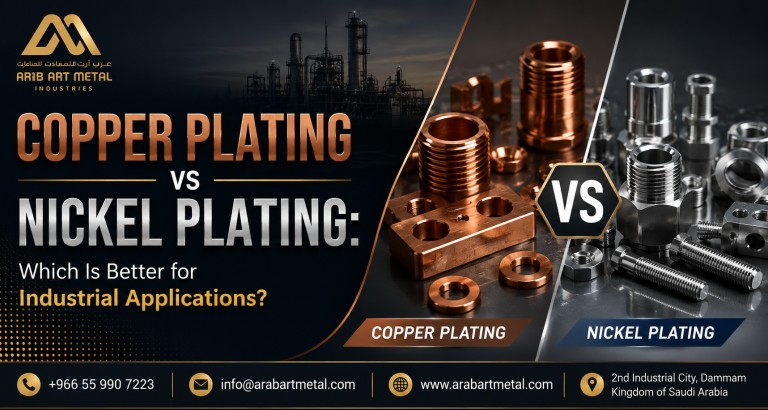
Copper Plating vs Nickel Plating for Industrial Applications
Updated August 2026 · 10 min read · arabartmetal.com
Choosing between copper plating and nickel plating isn’t a matter of picking the “better” metal in the abstract — it’s a matter of matching the plating to what the part actually has to survive. In copper plating vs nickel plating decisions, engineers and procurement teams are usually weighing three things at once: how the part will be used, what environment it will sit in, and what budget the project can absorb. Get the match wrong and you’re looking at premature corrosion, poor conductivity, or a finish that simply doesn’t hold up under repeated handling.
At Arab Art Metal, this is a question our team fields constantly, because the two finishes solve genuinely different problems. This guide breaks down how copper and nickel plating actually perform against each other, where each one earns its place on a production line, and how to think through the decision for your own application.
What Is Copper Plating?
Copper plating deposits a thin, electrically conductive layer of copper onto a base metal — typically steel, brass, or zinc die-cast parts — through an electroplating process. The part is submerged in a copper sulfate or copper cyanide solution, and an electrical current drives copper ions onto the surface, bonding them at a molecular level.
Copper is prized industrially for two properties above all: excellent electrical conductivity and outstanding adhesion as a base layer for further plating. It’s rarely used as a standalone finish in harsh environments because copper alone oxidises and tarnishes when exposed to air and moisture. Instead, it’s frequently used as an underlayer — a foundation coat that improves how well subsequent layers (nickel, chrome, gold) bond to the substrate.
Common industrial uses of copper plating:
- Electrical connectors, busbars, and terminals
- Printed circuit board (PCB) manufacturing
- Undercoating before nickel or chrome plating
- Heat sinks and thermal management components
- Ammunition and firearms components
What Is Nickel Plating?
Nickel plating also uses electrodeposition, but nickel behaves very differently once it’s on the part. Where copper is soft and conductive, nickel is hard, wear-resistant, and — critically for industrial use — far more resistant to corrosion and oxidation on its own.
There are two main types used industrially: electrolytic nickel plating, which uses electrical current like copper plating, and electroless nickel plating, which uses a chemical reduction process instead of electricity. Electroless nickel is particularly valued for coating parts with complex geometries, since it deposits an even layer regardless of shape — something electrolytic processes struggle with on recessed or irregular surfaces.
Common industrial uses of nickel plating:
- Machine tooling and industrial hardware
- Automotive components exposed to moisture and road salt
- Valves, fittings, and hydraulic parts
- Marine and offshore equipment
- Parts requiring a hard, wear-resistant surface before final finishing
Copper Plating vs Nickel Plating: Head-to-Head Comparison
| Property | Copper Plating | Nickel Plating |
|---|---|---|
| Corrosion resistance | Poor when exposed directly; tarnishes and oxidizes | Strong; resists rust, moisture, and chemical exposure |
| Electrical conductivity | Excellent — among the best of common plating metals | Moderate — noticeably lower than copper |
| Hardness / wear resistance | Soft; scratches and wears easily | Hard; holds up under friction and repeated contact |
| Typical role | Underlayer / base coat, or conductivity-focused parts | Standalone protective and decorative finish |
| Cost | Generally lower material cost | Moderately higher, especially electroless nickel |
| Best environment | Indoor, low-moisture, low-abrasion settings | Outdoor, humid, or chemically exposed environments |
| Common pairing | Often plated under nickel or chrome | Often plated over copper for a finished part |
Corrosion Resistance: Where Nickel Pulls Ahead
If the part is going to sit outdoors, near saltwater, or in a humid industrial environment, nickel plating is almost always the stronger choice. Nickel forms a passive oxide layer that protects the base metal beneath it, which is why it shows up so often on automotive, marine, and outdoor hardware. Copper, left unprotected, oxidizes into a dull, sometimes greenish patina — fine for some decorative or indoor applications, but not something you want on a part that has to resist weather or chemical exposure.
This is also why the two finishes are frequently combined rather than treated as competitors: a copper underlayer improves adhesion and smooths the substrate, and a nickel top layer handles the actual corrosion protection. This “copper-then-nickel” system is standard practice in a lot of decorative chrome plating too, where copper, nickel, and chrome are applied in sequence, each layer doing a different job.
Electrical Conductivity: Copper’s Clear Advantage
For any application where the plated part needs to carry current — connectors, terminals, busbars, PCB traces — copper is the obvious pick. Its conductivity is significantly higher than nickel’s, and in electrical work, that difference translates directly into lower resistive losses and better performance. Nickel is sometimes used on electrical contacts anyway, but usually for its wear resistance and corrosion protection on the contact surface, not for conductivity — and often as a thin flash over a copper base rather than in place of it.
Hardness and Durability Under Mechanical Stress
Nickel plating holds up considerably better under abrasion, repeated handling, and mechanical wear. This makes it the go-to for tooling, fasteners, valve components, and anything that experiences friction or frequent contact in service. Copper is comparatively soft — it dents, scratches, and wears down faster, which is part of why it’s rarely specified as a final, exposed surface on parts that see mechanical stress.
Cost Considerations for Industrial Projects
Copper plating is generally the more economical option on raw material cost alone, which is one reason it’s so common as an underlayer rather than being replaced with a more expensive metal for a coat that will be covered anyway. Nickel plating, particularly electroless nickel, tends to run higher due to both material and process costs — but that premium buys corrosion resistance and durability that often lowers the total cost of ownership over the life of the part, since it needs less rework, refinishing, or early replacement.
Which Should You Choose? A Practical Framework
Rather than asking “which plating is better” in the abstract, it helps to ask three questions about the specific part:
- Will it be exposed to moisture, weather, or chemicals? If yes, lean nickel — or a copper-nickel combination.
- Does the part need to conduct electricity? If yes, copper (often with a thin protective nickel or other overcoat if exposure is a concern).
- Will it experience friction, impact, or repeated handling? If yes, nickel’s hardness will outlast copper’s softer surface.
For many industrial parts, the honest answer isn’t “copper or nickel” — it’s “copper, then nickel,” using each metal for what it does best in a layered system.
Why Work With a Specialised Plating Partner
Getting the plating right isn’t just about picking the metal — it’s about surface preparation, plating thickness, bath chemistry, and process control, all of which affect how the finish actually performs in the field. A poorly prepared substrate or inconsistent plating thickness can undermine even the right metal choice. This is where working with an experienced plating shop matters: the process control behind the plating is often what separates a finish that lasts from one that fails early.
Arab Art Metal has worked across both copper and nickel plating for industrial clients who need finishes that hold up in real operating conditions, not just on paper. Whether you’re finishing electrical components, tooling, or parts headed for outdoor or industrial-chemical exposure, our plating and metal finishing services are built around matching the process to the part, not applying a one-size-fits-all coat.
Frequently Asked Questions
1. Is nickel plating better than copper plating?
It depends on the application. Nickel is better for corrosion resistance and hardness; copper is better for electrical conductivity and as a base layer under other platings. Neither is universally “better” — they’re suited to different jobs.
2. What is copper plating used for?
Copper plating is used for electrical components (connectors, terminals, PCBs), as an underlayer before nickel or chrome plating, and in applications where high conductivity matters more than corrosion resistance.
3. Does copper plating rust?
Copper doesn’t rust in the way steel does, but it does oxidize and tarnish when exposed to air and moisture, developing a dull or greenish patina over time unless it’s protected by a topcoat.
4. Can you plate nickel over copper?
Yes — this is a standard industrial practice. Copper is often used as an underlayer because it bonds well to many base metals, and nickel is then plated over it to add corrosion resistance and hardness.
5. Which is more corrosion resistant, nickel or copper?
Nickel is significantly more corrosion resistant than unprotected copper. Nickel forms a protective oxide layer, while copper tarnishes and corrodes more readily when exposed directly to moisture and air.
6. Is copper plating good for outdoor use?
Generally no, not on its own. Copper plating exposed outdoors will tarnish and degrade faster than nickel. For outdoor or high-moisture applications, nickel plating or a copper-nickel layered system is the more durable choice.
7. How long does nickel plating last?
Service life varies with plating thickness, base metal, and environment, but nickel plating is known for long-term durability in industrial settings, particularly when properly applied over a well-prepared substrate.
8. What is the cheapest metal plating option?
Among common industrial platings, copper plating typically has a lower material cost than nickel, which is one reason it’s frequently used as a cost-effective underlayer beneath mor
