
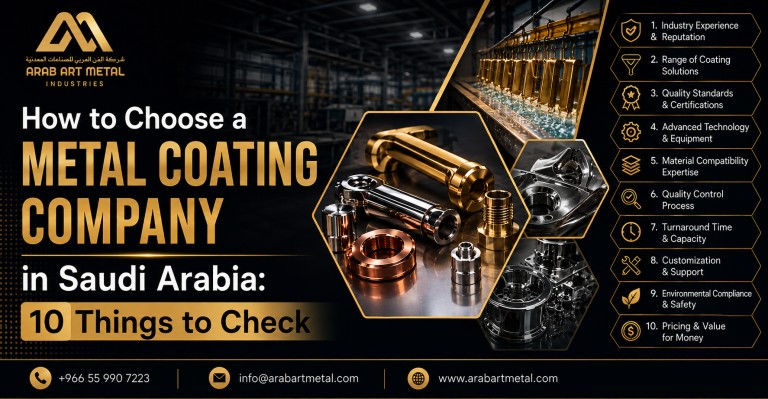
How to Choose a Metal Coating Company in Saudi Arabia: 10 Things to Check
Updated August 2026 · 10 min read · arabartmetal.com
Riyadh’s metro stations, its automotive workshops, and its new towers all depend on a decision most facility managers make only once every few years: which metal coating company gets the job. Get it right and a finish holds up for a decade in the desert heat. Get it wrong and you’re paying to recoat within eighteen months. If you’re comparing a metal coating company in Saudi Arabia right now, the pitches will sound almost identical — “premium quality,” “advanced technology,” “trusted since [year].” What actually separates a dependable partner from a risky one is a short, concrete checklist. Here are the ten things worth confirming before you sign anything.
1. Confirm Which Coating Processes They Actually Run In-House
Not every company that advertises “metal coating” owns the equipment behind the claim — some subcontract the actual plating or finishing work and simply manage the client relationship. That extra layer adds cost, slows communication, and makes it harder to hold anyone accountable if a batch comes back wrong. Ask directly whether gold, silver, copper, nickel, and bronze electroplating happen on their own floor, and whether metal finishing work such as brushing, antiquing, or mirror polishing is done in-house too. A company running its own tanks and finishing lines can control timelines and quality far more tightly than one coordinating between two or three vendors.
2. Ask for Certifications and Quality Standards
Certifications won’t guarantee a flawless finish, but their absence is a real warning sign. Ask whether the company works to ISO 9001 quality management practices, whether their processes align with Saudi Standards, Metrology and Quality Organization (SASO) requirements, and whether they test coatings for adhesion and corrosion resistance using recognized methods such as salt-spray (ASTM B117) testing. A company that can explain its quality checks in specific terms — not just “we test everything” — is usually one that actually has a documented process behind the scenes.
3. Check Their Experience With Your Specific Metal and Industry
Coating a jewelry piece, a staircase railing, and an oil-and-gas valve component are three completely different jobs, even though all three might be described as “electroplating.” Base metal, load-bearing requirements, and exposure conditions all change the right process and the right thickness of coating. Ask the company to walk you through projects they’ve handled in your specific category — automotive interiors, architectural features, industrial components, or recognition items like custom awards and trophies. A team that has genuinely worked across these categories will talk about trade-offs and constraints, not just finished-product photos.
4. Inspect Past Work and Request Real References
Photos on a website are curated by definition. Before committing, ask to see a broader portfolio of completed work, and if possible, ask for the contact details of a past client in a similar industry to yours. A company confident in its output won’t hesitate to connect you, or to show you a piece in person so you can check the finish under natural light rather than a studio photo. If a supplier is reluctant to provide any verifiable reference, treat that as useful information in itself.
5. Understand Their Equipment and Technology
Saudi Arabia’s metal fabrication sector has been modernizing quickly under Vision 2030 — industry research firm IMARC Group valued the Kingdom’s metal fabrication market at over $680 million in 2024, with continued growth expected through 2033 as giga-projects and industrial diversification drive demand [1]. That growth has pushed serious players toward automated plating lines, precision laser engraving, and sandblasting equipment rather than manual, small-batch setups. Ask what equipment a prospective partner runs day to day, and whether it’s been upgraded in the last few years. Older, manual equipment isn’t automatically disqualifying, but it does mean tighter tolerances and larger runs may take longer or cost more.
6. Ask About Corrosion Resistance for the Saudi Climate
Riyadh’s heat and dust are one challenge; the humidity and salt air in Jeddah or Dammam are another entirely. A coating that performs well in a dry inland climate can fail faster on the coast. Ask specifically about corrosion-resistant coating options, how the company tests for it, and whether they’d recommend a different finish depending on where the piece will actually sit. A company that references organizations like AMPP (the Association for Materials Protection and Performance, formerly NACE) when discussing corrosion protocols is signaling that this isn’t an afterthought for them.
7. Get Clarity on Turnaround Time and Capacity
Timelines vary enormously depending on project size and finish complexity. Small decorative pieces or trophies often move through in a matter of days, while larger architectural or industrial projects can reasonably take a week or more once surface preparation, plating, curing, and quality checks are all accounted for. What matters isn’t just the number quoted, but whether the company gives you a clear, written timeline before work starts — and whether they have the capacity to handle both a one-off custom piece and a large bulk order without one delaying the other.
8. Compare Customization and Finish Options
A narrow finish menu limits what you can actually do with a project. Look for a services page or catalog that covers brushed, matte, glossy, mirror, and antique finishes, and ask whether they can match a specific finish you’ve seen elsewhere or provide physical samples before a full production run. For architectural or automotive interior work in particular, the difference between a good and a mediocre supplier often comes down to how many finish variations they can genuinely deliver, not just describe.
9. Look at Pricing Structure and Transparency
The cheapest quote on paper is rarely the cheapest outcome. Ask for a written, itemized quote that separates surface preparation, the coating or plating process itself, finishing, and any rush fees, rather than a single lump figure. Ask what warranty applies if the coating chips, discolors, or corrodes earlier than expected, and get that in writing too. A company that’s transparent about cost breakdowns is usually just as transparent about problems if something goes wrong later.
10. Evaluate Communication, Support, and After-Sales Service
Metal coating is rarely a one-and-done transaction — most industrial and architectural clients come back for maintenance, touch-ups, or follow-on batches. Before signing, gauge how responsive the company is at the enquiry stage, whether they can communicate comfortably in both Arabic and English, and whether they offer any post-project support if a finish needs attention. Checking a company’s background and history and reaching out directly through their contact channels before committing tells you a lot about how they’ll behave once the invoice is paid.
Quick Reference: Green Flags vs. Red Flags
Use this table as a fast gut-check while you’re comparing quotes.
| What to Check |
Green Flag |
Red Flag |
| Processes | Plating and finishing done in-house | Work is quietly subcontracted out |
| Certifications | Cites ISO / SASO and testing methods | Vague “quality guaranteed” claims only |
| Experience | Can discuss your specific metal/industry | Only shows generic stock photos |
| References | Happy to share past clients or site visits | Reluctant to provide any references |
| Climate fit | Adjusts recommendation by region (Riyadh vs. coast) | One finish recommended for every location |
| Pricing | Itemized quote with written warranty | Single lump-sum price, no warranty terms |
| Communication | Responsive in Arabic and English | Slow replies before you’ve even signed |
Getting This Right the First Time
Arab Art Metal Industries has been running electroplating and metal finishing operations from Riyadh since 2017, working across automotive, architectural, industrial, and recognition projects — including custom awards and trophies — for clients across the Kingdom. If you’re comparing metal coating services for an upcoming project, get in touch through our contact page for a written quote and a straight answer on timeline before you commit to anyone.
👉 Get a Free Consultation
Frequently Asked Questions
1. What should I look for in a metal coating company?
Prioritise in-house processing capability, relevant certifications, proven experience with your metal and industry, transparent pricing, and clear communication. A company that can answer specifics about equipment and testing rather than only marketing language is generally the safer choice.
2. How much does metal coating cost in Saudi Arabia?
Cost depends on the base metal, coating type (gold and silver plating cost more than nickel or copper), piece size, and finish complexity. Get an itemised quote rather than comparing single lump-sum figures across suppliers, since the breakdown reveals what you’re actually paying for.
3. What is the difference between electroplating and powder coating?
Electroplating uses an electrical current to bond a thin metal layer — gold, silver, nickel, copper, or bronze — onto a surface, which is common for decorative, jewellery, and architectural detail work. Powder coating applies a dry polymer that’s cured under heat, which tends to suit larger industrial parts needing a thicker, more impact-resistant layer.
4. How long does a metal coating project take?
Small decorative items or trophies often complete within a few days. Larger architectural or industrial projects can take a week or more once surface preparation, plating or coating, and curing are factored in. A reliable supplier will give you a specific written timeline rather than a rough estimate.
5. Which metal coating holds up best in Saudi Arabia’s climate?
It depends on location as much as metal type. Inland cities like Riyadh deal mainly with heat, dust, and UV exposure, while coastal cities like Jeddah and Dammam add salt-air corrosion into the mix. Corrosion-resistant coatings tested against recognised standards are worth prioritising for any outdoor or coastal installation.
6. Are Saudi metal coating companies certified to international standards?
Reputable companies typically align with ISO quality management practices and SASO requirements, and test coatings using internationally recognized methods. It’s reasonable to ask a prospective supplier to name the specific standards and tests they follow rather than accepting a general assurance.
7. Can a metal coating company refinish old or used parts?
Many can, though it usually requires additional surface preparation to strip old coatings, corrosion, or damage before a new layer is applied. Ask specifically whether the company handles refinishing and restoration work, since not every supplier is set up for it.
