
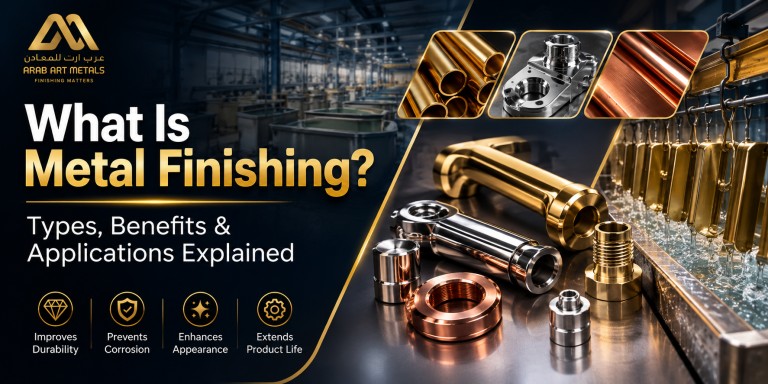
What Is Metal Finishing? Types, Benefits & Applications Explained
Updated August 2026 · 10 min read · arabartmetal.com
Walk through any factory floor, showroom, or hardware store, and you’re surrounded by metal finishing — you just may not recognise it. That gleaming chrome fixture, the matte-black bracket under your car’s hood, the anodised aluminium casing on a laptop: all of it passed through a finishing process before it reached the end user. So what is metal finishing, exactly? It’s the set of surface treatment processes applied to metal parts and products after fabrication, designed to improve appearance, durability, and performance. Rather than being a cosmetic afterthought, metal finishing is often the difference between a part that lasts five years and one that lasts fifty.
At Arab Art Metal, this is the work we do every day — turning raw, machined, or cast metal into components that are ready for the real world, whether that’s a humid coastal environment, a high-friction industrial setting, or a customer-facing product that needs to look flawless. In this guide, we’ll break down what metal finishing actually involves, the main types of processes used across industry, the practical benefits it delivers, and where you’ll find it applied.
What Does Metal Finishing Actually Mean?
Metal finishing refers to any process performed on the surface of a metal object after its primary shaping (casting, forging, machining, or stamping) is complete. The goal is almost always one of three things, and often a combination of all three:
- Protection — guarding against rust, oxidation, and chemical attack
- Performance — improving wear resistance, conductivity, or surface hardness
- Presentation — achieving a specific colour, texture, or shine
Unfinished metal is vulnerable. Raw steel rusts. Bare aluminium oxidises and dulls. Machined parts can carry micro-burrs and inconsistencies that affect how they fit and function. Metal finishing addresses these issues at the surface level, without altering the structural integrity of the part underneath.
Why Metal Finishing Matters
Untreated metal surfaces are chemically reactive. Iron and steel oxidize into rust when exposed to moisture and oxygen. Aluminum forms a natural oxide layer that, left uncontrolled, can flake and weaken over time. Even “stainless” steel can corrode under the wrong conditions if its passive layer is compromised. Finishing processes either build a protective barrier on top of the metal or chemically alter the surface layer itself to resist this breakdown.
Beyond protection, finishing affects how parts perform mechanically. A polished bearing surface reduces friction. A hardened, finished gear tooth resists wear far longer than an untreated one. And for consumer-facing products, finish is often the first — and sometimes only — quality signal a customer notices.
Types of Metal Finishing Processes
There isn’t one single “metal finishing” process — it’s an umbrella term covering a wide range of techniques, each suited to different metals, environments, and end goals. Here are the main categories.
1. Electroplating
Electroplating uses an electrical current to deposit a thin layer of metal (such as chrome, nickel, zinc, or gold) onto the surface of a base material. It’s one of the most widely used finishing methods because it combines corrosion resistance with a decorative, uniform appearance. Chrome-plated automotive trim and nickel-plated hardware are classic examples.
2. Anodizing
Anodizing is an electrochemical process used almost exclusively on aluminum and a handful of other non-ferrous metals. It thickens the metal’s natural oxide layer, creating a hard, corrosion-resistant surface that can also be dyed in a range of colors. Because the finish becomes part of the metal itself rather than a coating sitting on top, anodized surfaces resist chipping and peeling in a way plated surfaces sometimes can’t.
3. Powder Coating
Powder coating applies a dry, electrostatically charged powder to a metal surface, which is then cured under heat to form a hard, even shell. It produces a thicker, more durable finish than liquid paint, with excellent resistance to chipping, scratching, and fading — which is why it’s a favorite for outdoor furniture, railings, and architectural metalwork.
4. Polishing and Buffing
These are mechanical processes that use abrasives and rotating wheels to smooth a metal surface and bring out its natural shine. Polishing removes surface imperfections and levels the metal, while buffing refines it further to a mirror-like luster. This is common on stainless steel fixtures, brass fittings, and decorative metalwork.
5. Galvanizing
Galvanizing coats steel or iron with a layer of zinc, most commonly through a hot-dip process where the metal is submerged in molten zinc. The zinc layer sacrifices itself to corrosion before the underlying steel does, making galvanizing a go-to choice for structural steel, fencing, and outdoor infrastructure exposed to the elements.
6. Passivation
Passivation is a chemical treatment typically used on stainless steel. It removes free iron and other contaminants from the surface, allowing the metal’s natural chromium oxide layer to form more completely. This restores and strengthens the corrosion resistance that stainless steel is known for, especially after machining or welding.
7. Brushing
Brushing creates a fine, linear texture on the metal surface using abrasive belts or wheels. It’s less reflective than polishing and is often chosen for its clean, understated aesthetic — think brushed stainless steel appliances or architectural panels.
| Finishing Type | Primary Purpose | Common Metals | Typical Use Case |
|---|---|---|---|
| Electroplating | Corrosion resistance + decorative finish | Steel, brass, zinc die-cast | Automotive trim, hardware, fixtures |
| Anodizing | Hard, colorable protective layer | Aluminum, titanium | Consumer electronics, architectural facades |
| Powder Coating | Durable, chip-resistant color coating | Steel, aluminum | Outdoor furniture, railings, machinery |
| Polishing/Buffing | Aesthetic shine, surface smoothing | Stainless steel, brass, aluminum | Decorative fittings, kitchenware |
| Galvanizing | Sacrificial corrosion protection | Steel, iron | Structural steel, fencing, outdoor infrastructure |
| Passivation | Restore corrosion resistance | Stainless steel | Medical, food-grade, and industrial components |
| Brushing | Textured, matte aesthetic | Stainless steel, aluminum | Appliances, architectural panels |
Key Benefits of Metal Finishing
Corrosion and Rust Resistance This is the most fundamental benefit. Whether through a sacrificial coating (galvanizing), a barrier layer (powder coating), or a chemically strengthened surface (anodizing, passivation), finishing dramatically extends the service life of metal parts exposed to moisture, chemicals, or outdoor conditions.
Improved Durability and Wear Resistance Finished surfaces are often harder and more resistant to abrasion than raw metal. This matters enormously in moving parts, tooling, and components subject to repeated friction or mechanical stress.
Enhanced Appearance For consumer products, architectural elements, and branded hardware, appearance sells. Polishing, plating, and coating processes give manufacturers control over color, texture, and shine — letting them match a design vision precisely.
Better Adhesion for Subsequent Coatings Some finishing processes, like passivation or certain pre-treatments, prepare a metal surface so that paint, adhesives, or additional coatings bond more effectively later in production.
Electrical and Thermal Performance Certain finishes, particularly specific electroplated layers, are chosen specifically for their conductive or insulating properties — critical in electronics and electrical hardware manufacturing.
Cost Savings Over Time While finishing adds an upfront processing cost, it substantially reduces long-term costs from part replacement, maintenance, and downtime caused by corrosion or wear failure.
Applications of Metal Finishing Across Industries
Metal finishing touches nearly every sector that works with metal components:
- Automotive — chrome trim, plated fasteners, powder-coated wheels and chassis components
- Architecture and Construction — anodized aluminum facades, powder-coated railings, galvanized structural steel
- Furniture and Interior Design — polished and brushed stainless steel fittings, decorative hardware
- Electronics — gold and nickel plating on connectors and contacts for conductivity
- Industrial Equipment and Machinery — hardened, wear-resistant finishes on gears, shafts, and tooling
- Marine and Outdoor Infrastructure — galvanized and specially coated steel to withstand salt and moisture exposure
- Consumer Goods — everything from kitchenware to fixtures, where finish quality directly affects perceived value
Frequently Asked Questions
1. What is the purpose of metal finishing?
Metal finishing protects metal surfaces from corrosion and wear, improves mechanical performance, and enhances appearance — all without changing the underlying structural properties of the part.
2. What are the different types of metal finishing?
The main types include electroplating, anodising, powder coating, polishing and buffing, galvanising, passivation, and brushing. Each suits different metals and end goals.
3. What is the most common metal finishing process?
Electroplating and powder coating are among the most widely used industrial finishing processes, thanks to their versatility, durability, and cost-effectiveness across a wide range of applications.
4. How does metal finishing prevent corrosion?
Finishing either creates a physical barrier between the metal and the environment (like powder coating), a sacrificial layer that corrodes first (like galvanising), or strengthens the metal’s natural protective oxide layer (like anodising and passivation).
5. What industries use metal finishing the most?
Automotive, construction and architecture, electronics, furniture, industrial manufacturing, and marine infrastructure are among the heaviest users of metal finishing services.
6. Is metal finishing the same as electroplating?
No. Electroplating is one specific type of metal finishing. Metal finishing is the broader category that also includes anodising, powder coating, polishing, galvanising, and more.
7. How do you choose the right metal finish?
The right finish depends on the base metal, the environmental conditions the part will face, required durability and appearance, and budget. A finishing specialist can assess these factors and recommend the most suitable process.
8. What is the difference between metal finishing and metal coating?
Metal coating typically refers to applying a separate material (like paint or powder) on top of the metal surface. Metal finishing is the broader term that includes coatings as well as processes that transform the metal’s own surface, like anodising and polishing.
Conclusion
If you’re specifying a finish for a new project or need to solve a corrosion, durability, or appearance issue on existing metal components, Arab Art Metal offers a full range of metal finishing and electroplating services tailored to your material, environment, and application. Explore our metal finishing services or get in touch with our team to discuss the right finish for your project.
