

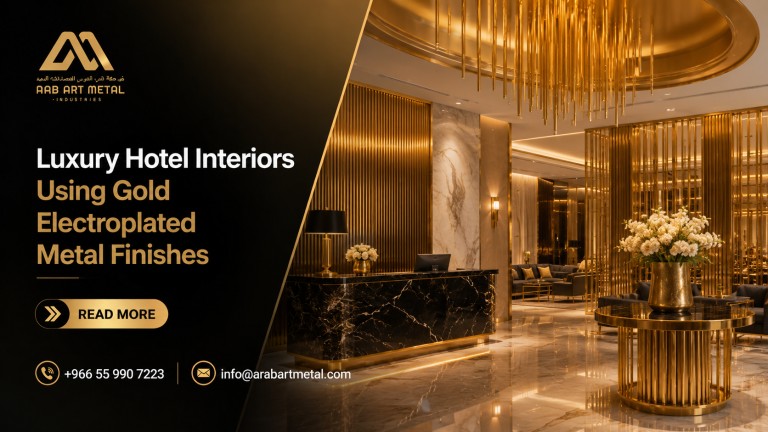
Luxury Hotel Interiors Using Gold Electroplated Metal Finishes
Introduction: Where Opulence Meets Engineering
In the world of 5-star hospitality, first impressions are everything. The moment a guest steps into a luxury hotel lobby, every surface speaks a silent language — and gold electroplated metal finishes speak louder than almost anything else. From shimmering elevator surrounds to custom-crafted reception counters, gold-plated metalwork has, therefore, become the defining aesthetic of high-end hotel interiors across the globe.
However, this is not merely about glitter and glamour. Modern gold electroplating is a precision science — a marriage of advanced electrochemical engineering and artistic craftsmanship. When applied correctly, it delivers surfaces that are not just visually magnificent, but also durable, corrosion-resistant, and uniquely customisable to a hotel’s brand identity.
At Arabart Metals, we specialise in gold electroplating and decorative metal finishing solutions crafted for the luxury hospitality sector. In this guide, we take you through everything hotel designers, architects, and procurement professionals need to know about gold electroplated metal finishes — from the electroplating process itself to real-world hotel applications, care tips, and how to choose the right finishing partner.
1. What Is Gold Electroplating? A Technical Overview
 Gold electroplating is an electrochemical process in which a thin layer of gold bonds onto a base metal — typically brass, stainless steel, or copper — using an electric current. The object to be plated sits submerged in a gold electrolyte solution and connects to the cathode of an electrical circuit. Gold ions in the solution then reduce and deposit uniformly onto the surface, creating a bonded metallic layer.
Key Technical Parameters:
- Thickness: Decorative applications typically range from 0.05–1.0 microns; heavy-wear surfaces can go up to 5 microns
- Gold Purity: 18K, 22K, and 24K options each delivering a different hue (rose gold, yellow gold, deep yellow)
- Base Metals: Brass, stainless steel, mild steel, copper, aluminium
- Finish Types: Polished mirror, brushed satin, hammered, PVD-enhanced gold
Unlike gold paint or gold foil, electroplated surfaces bond chemically to the substrate — meaning they will not peel, flake, or chip under normal conditions when properly maintained.
2. Why Gold Finishes Dominate Luxury Hotel Design
Visual Authority
Gold commands attention. For instance, a gold-plated column base, a gilded ceiling feature, or gold-finished door hardware immediately signals exclusivity and elevates the perceived value of an interior space.
Brand Differentiation
No two hotels are identical, and gold finishes can be tuned precisely in shade, texture, and sheen to reflect a hotel’s unique brand palette. For example, warm yellow gold conveys classical grandeur; rose gold suggests modern romance; and brushed gold communicates understated sophistication.
Versatility Across Applications
Moreover, gold electroplating suits a diverse range of architectural and decorative elements — lobby features, FF&E (Furniture, Fixtures & Equipment), restaurant interiors, spa areas, guest room accents, and exterior facade features.
Longevity and ROI
A high-quality electroplated finish, when sealed and maintained correctly, offers a service life of 15–25 years in interior environments. Consequently, compared to the recurring cost of repainting, re-laminating, or replacing decorative elements, electroplating delivers exceptional long-term ROI for hotel operators.
3. Gold Electroplating Applications in Luxury Hotel Interiors
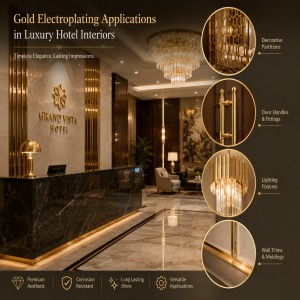
 The breadth of gold electroplating applications in a luxury hotel environment is extensive, as it combines aesthetic elegance, durability, and long-term value. Indeed, gold-plated finishes enhance luxury hospitality spaces with elegance, sophistication, and exclusivity. Below are the most impactful areas where this finish makes its mark:
a) Grand Lobby Features
Hotel lobbies set the tone for a guest’s entire stay. Specifically, gold-plated reception desks, column cladding, ceiling medallions, chandelier frames, and elevator cab interiors rank among the most popular applications. In fact, the lobby is where design investment yields the highest brand return.
b) Doors, Handles, and Hardware
Even small surface details matter enormously in luxury hospitality. In particular, gold-plated door handles, push plates, hinges, and fittings are among the most tactile luxury signals — guests touch them repeatedly, and quality is immediately perceptible.
c) Restaurant & Bar Interiors
F&B spaces within 5-star hotels increasingly rely on gold metal accents to create atmosphere. For example, bar fronts, table-base cladding, wine display frames, pendant light fixtures, and partition screens in gold-plated metal create spaces that photograph beautifully and attract social media attention.
d) Spa and Wellness Areas
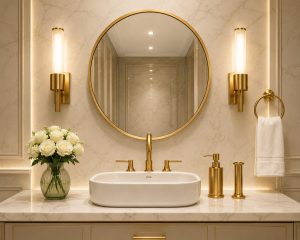
The wellness sector within luxury hotels embraces gold for its sensory richness. Accordingly, gold-finish taps, shower fixtures, mirror frames, and wall accents in spa environments reinforce the feeling of indulgence and self-care.
e) Exterior Facade Accents
High-end hotels in the Middle East, Asia, and Europe increasingly incorporate gold-finished metal cladding panels, entrance canopy frames, and signage elements into their exterior architecture. For outdoor applications, PVD (Physical Vapour Deposition) gold coating is therefore recommended for its superior UV and weather resistance.
f) Custom FF&E
Custom furniture — coffee tables, console tables, display cabinets, headboards, and room dividers — with gold electroplated metal frames or legs is a hallmark of bespoke hotel interior projects. These pieces are designed to specification and fabricated to reflect the hotel’s design narrative.
4. Gold Electroplating vs. Gold PVD Coating: Which Is Right for Your Hotel?
Both gold electroplating and gold PVD (Physical Vapour Deposition) coating are widely used in luxury hotel interiors. However, the choice between them depends on the application environment and durability requirements:
| Feature | Gold Electroplating | Gold PVD Coating |
| Process | Electrochemical deposition | Physical vapour deposition |
| Hardness | Moderate | Very high (scratch-resistant) |
| Finish Options | Mirror, satin, brushed | Mirror, satin, brushed |
| Outdoor Use | Not recommended | Excellent (UV stable) |
| Indoor Use | Excellent | Excellent |
| Customisation | High (purity, thickness) | High (colour, texture) |
| Longevity (Interior) | 15–20 years | 20–25+ years |
| Cost | Moderate | Higher initial cost |
At Arabart Metals, we offer both technologies and work with hotel designers and procurement teams to recommend the right solution for each application zone. Explore our PVD coating services and gold electroplating services to learn more.
5. The Arabart Metals Process: From Design Brief to Installation
What sets premium electroplating providers apart is not just the finish — it’s the entire process from concept to completion. Here is how Arabart Metals approaches a luxury hotel project:
Step 1 — Design Consultation
First, our team works directly with interior designers, architects, and hotel procurement managers to understand the design brief, brand guidelines, and finish specifications required.
Step 2 — Material & Finish Selection
Next, we advise on base material, gold purity (18K, 22K, 24K), finish texture (mirror, satin, brushed, hammered), and thickness based on the application zone and durability requirements.
Step 3 — Surface Preparation
After that, all substrate surfaces undergo cleaning, degreasing, and polishing to the desired texture before plating. Surface preparation is critical — any imperfections in the base will show through the gold layer.
Step 4 — Electroplating
We then carry out the plating in a controlled bath environment, with strict monitoring of current density, temperature, and electrolyte composition. This ensures uniformity and consistency across all pieces — critical for large hotel projects with many matching components.
Step 5 — Quality Control & Sealing
Subsequently, every finished piece undergoes inspection under controlled lighting for uniformity, adhesion, and colour consistency. We then apply a lacquer or clear PVD topcoat to protect the gold layer in high-traffic areas.
Step 6 — Packaging and Delivery
Finally, our team individually wraps and crates each gold-plated element to prevent transit damage, and delivers them with installation guidance documentation.
6. Maintenance and Care of Gold Plated Hotel Surfaces
Gold-plated surfaces require appropriate maintenance to preserve their appearance over time, particularly in the demanding hotel environment. Here are best practice guidelines for hotel maintenance teams:
Daily and Routine Care
- Use only pH-neutral, non-abrasive cleaning agents
- Apply with soft microfibre cloths — never abrasive pads or steel wool
- Avoid bleach-based or acidic cleaners (particularly near spa and pool areas)
- Wipe up water droplets promptly in humid environments (bathrooms, spas)
- Arrange periodic professional re-lacquering every 7–10 years in high-contact zones
- For outdoor PVD-gold surfaces, a mild soap-and-water rinse is sufficient
Following these guidelines will preserve the luminosity and integrity of gold-finished surfaces across the full lifecycle of the hotel interior.
7. Sustainability in Gold Electroplating
As luxury hotel brands increasingly prioritise sustainability credentials, it is important to note that modern gold electroplating has made significant advances in environmental responsibility. Specifically, these advances include:
- Closed-loop plating systems that recover and recycle gold from the bath solution, significantly reducing waste
- Water-treatment systems that neutralise effluent before discharge
- The longevity of electroplated surfaces, which reduces the frequency of replacement — directly reducing material consumption and waste
- PVD coating, which is inherently a dry, solvent-free process with minimal environmental impact
Furthermore, Arabart Metals adheres to responsible manufacturing practices and can provide documentation to support hotel sustainability certifications (LEED, Green Key, etc.).
Final Thoughts
 Gold electroplated metal finishes occupy a unique intersection of art, engineering, and hospitality excellence. For luxury hotels, they represent far more than a decorative choice — they are a tangible investment in brand perception, guest experience, and property value.
Indeed, the evolution of gold electroplating technology has made this finish more accessible, more durable, and more customisable than ever before. Whether you are designing a grand lobby that will define a city’s skyline, refurbishing a boutique hotel’s restaurant, or sourcing bespoke FF&E for a new resort, gold-plated metal finishes offer unrivalled aesthetic authority.
Ultimately, what makes the difference is the quality of the partner you choose. Precision in surface preparation, consistency in plating thickness, rigour in quality control, and experience in hospitality-specific applications are what separate ordinary metalwork from genuinely extraordinary finishing.
Frequently Asked Questions
Q1: What is gold electroplating and how is it used in hotel interiors?
A: Gold electroplating is an electrochemical process where a thin layer of pure gold bonds onto a base metal using an electric current. In luxury hotel interiors, specialists apply it to lobby features, elevator cabs, door hardware, restaurant fixtures, custom furniture, and decorative architectural elements to create opulent, durable gold-finished surfaces that reflect the hotel’s prestige and brand identity.
Q2: How durable is gold electroplating in a hotel environment?
A: When correctly applied with an appropriate thickness (0.5–1 micron for decorative, up to 5 microns for high-wear areas) and sealed with a protective lacquer or PVD topcoat, gold-electroplated surfaces can maintain their appearance for 15–25 years in interior hotel environments. However, durability depends heavily on surface preparation, plating quality, and ongoing maintenance practices.
Q3: What is the difference between gold electroplating and gold PVD coating for hotels?
A: Gold electroplating uses a wet electrochemical bath process and is ideal for intricate decorative objects and detailed metalwork. In contrast, gold PVD coating uses a dry physical vapour deposition process and is harder, more scratch-resistant, and better suited for outdoor applications or high-traffic areas. Arabart Metals offers both and recommends the appropriate technology based on the specific application zone and performance requirements.
Q4: Can Arabart Metals match a specific gold tone or shade for our hotel’s brand?
A: Yes. Arabart Metals offers a range of gold finishes including 18K warm gold, 22K yellow gold, 24K deep gold, and rose gold, as well as custom colour development. Moreover, we provide sample swatches for designer approval before full production begins, ensuring the finished elements align precisely with your hotel’s brand colour palette.
Q5: What base metals can be gold electroplated?
A: The most common base metals for gold electroplating in hotel interiors are brass, stainless steel, copper, and mild steel. Additionally, aluminium can also be plated with proper pre-treatment. The choice of base metal affects the final appearance, weight, and cost of the finished product.
