
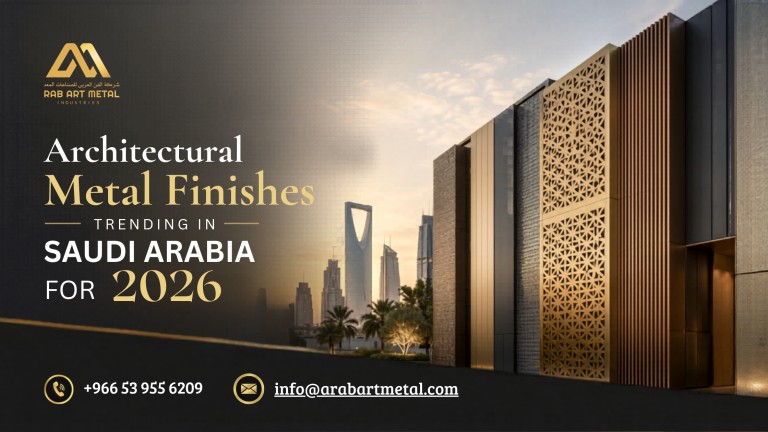
Architectural Metal Finishes Trending in Saudi Arabia for 2026
Published June 2, 2026 · KSA Architecture Insights · 9 min read
| Saudi Arabia’s construction landscape is being redrawn at a historic pace. Giga-projects, luxury tourism destinations, and urban mega-developments are driving unprecedented demand for architectural metal finishes that are not only visually striking, but engineered to endure the Kingdom’s extreme climate. Here is a definitive guide to the metal finishes defining KSA’s built environment in 2026. |
Key Market Statistics
| $11B+
Metal Sheets Marketprojected by 2030 |
55K+
New hotel roomsin the pipeline |
4.89%
CAGR of KSA architecturalcoatings 2026–2031 |
Why Metal Finishes Are Central to KSA Architecture in 2026
Saudi Arabia is simultaneously the world’s most ambitious construction market and one of its most technically demanding. With summer temperatures exceeding 48°C, UV radiation that bleaches and degrades inferior coatings within months, periodic sandstorms that abrade exposed surfaces, and a rapidly expanding coastal hospitality sector contending with marine corrosion, selecting the right architectural metal finish is a decision with profound long-term consequences.
Vision 2030 giga-projects alone — from Diriyah Gate and King Abdullah Financial District to the Red Sea Project and Sindalah Island — account for billions of square metres of metal cladding, roofing, and facade requirements. Rapid urbanisation across Riyadh, Jeddah, and Dammam is further accelerating demand for modern architectural facades featuring aluminium composite panels and stainless steel sheet systems.
Beyond performance, there is a clear aesthetic agenda. Architects and developers are specifying finishes that speak to a dual identity: the Kingdom’s deep-rooted cultural heritage and its aspirations as a global luxury destination. The result is a palette that favours warm metallic tones, textural depth, and finishes that age with dignity rather than deterioration.
| Climate-First Finish Selection
Saudi Arabia’s harsh conditions — extreme UV, abrasive sand, and coastal salt mean finish durability must be evaluated before aesthetics. Every finish recommended in this guide has been assessed for performance in KSA’s specific environmental zones. |
The 6 Architectural Metal Finishes Trending in 2026
The following six finish categories are dominating specification across the Kingdom’s most significant architectural programmes, from premium hospitality and mixed-use towers to cultural institutions and luxury residential developments.
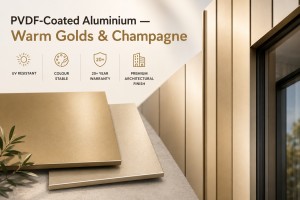 PVDF-Coated Aluminium — Warm Golds & Champagne PVDF-Coated Aluminium — Warm Golds & Champagne
Polyvinylidene fluoride coatings in warm gold, champagne, and de sert sand tones are dominating landmark hospitality and civic facades. Colour-stable for 20+ years under KSA’s intense UV load, these systems represent the highest-specification coating available for aluminium curtain wall and cladding systems. Top Trend 2026 UV Resistant 20+ Year Warranty |
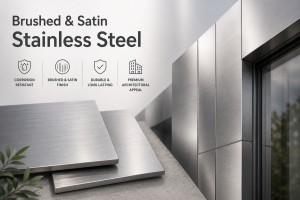 Brushed & Satin Stainless Steel Brushed & Satin Stainless Steel
The No. 4 satin and hairline finishes remain the prestige choice for high-end retail, hotel lobbies, and corporate towers. Their linear texture disguises minor abrasion from sand particles and maintains a refined, contemporary appearance across KSA’s arid interior zones. Classic Prestige Sand Resistant Interior & Exterior |
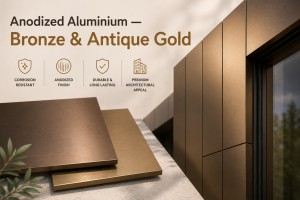 Anodized Aluminium — Bronze & Antique Gold Anodized Aluminium — Bronze & Antique Gold
Electrochemically formed oxide layers in bronze, antique gold, and espresso tones are specification staples for cultural institutions, mosques, and luxury residential towers that reference Islamic architectural tradition. The integral colour is harder than most coatings and will not peel or chip. Heritage Aesthetic Cultural Projects Integral Hardness |
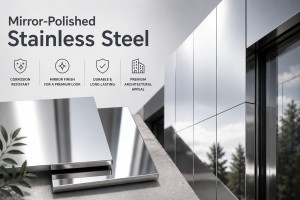 Mirror-Polished Stainless Steel Mirror-Polished Stainless Steel
Iconic reflective facades referencing the sky and desert light are gaining ground on high-visibility cultural and entertainment structures. Requires Grade 316L alloy specification in coastal Jeddah and Red Sea sites for adequate marine-environment resistance. Statement Facades Entertainment Requires 316L Coastal |
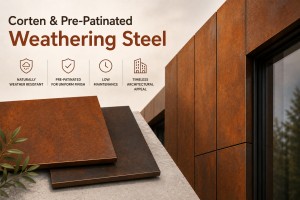 Corten & Pre-Patinated Weathering Steel Corten & Pre-Patinated Weathering Steel
Sealed or pre-patinated Corten is finding favour in cultural, heritage, and landscape architecture for its earthy russet palette that harmonises with Saudi Arabia’s desert topography and sandstone vernacular. Not recommended for coastal or marine environments. Cultural Projects Heritage Vernacular Interior Zones Only |
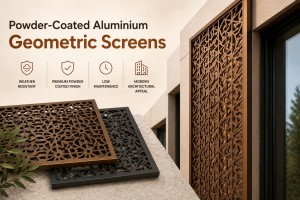
Electrostatically applied thermosetting powder coatings on perforated and patterned aluminium panels are used extensively for mashrabiya-inspired solar screens, balustrades, and entrance canopies across residential and commercial sectors throughout the Kingdom. Mashrabiya Screens Residential Custom Colours |
Climate Performance: Which Finish Survives Saudi Arabia’s Conditions?
Choosing the right finish is inseparable from understanding where in the Kingdom a project sits. The coastal humidity of Jeddah demands different protection than the bone-dry interior heat of Riyadh. The table below summarises performance characteristics for KSA’s primary environmental zones.
| Finish Type | Riyadh (Arid Interior) | Jeddah (Coastal) | NEOM / Red Sea |
| PVDF Aluminium | Excellent | Excellent | Excellent |
| Brushed Stainless 304 | Excellent | Moderate | Specify 316L |
| Anodized Aluminium | Excellent | Good | Moderate |
| Mirror Polish 316L | Excellent | Good | Good (316L) |
| Corten (Sealed) | Good | Not Recommended | Avoid |
| Powder Coat Aluminium | Excellent | Good | Good (UV-stabilised) |
Project Spotlights: Where These Finishes Are Being Specified
The following KSA projects illustrate how each finish category is being deployed across the Kingdom’s most significant architectural commissions.
| Diriyah Gate Heritage District
Pre-patinated Corten · Oxidized Bronze Anodize Saudi Arabia’s $63 billion heritage redevelopment extensively specifies warm metal finishes that reference the Kingdom’s clay-walled Najdi architectural tradition, anchoring contemporary steel construction within a desert vernacular. |
| KAFD Tower Precinct, Riyadh
PVDF Champagne Aluminium · Hairline Stainless The King Abdullah Financial District’s corporate towers favour PVDF-coated aluminium curtain wall systems in warm neutral tones, complemented by hairline stainless trim elements on podium levels and entrance canopies. |
| Red Sea Project — Coastal Resorts
316L Mirror Polish · PVDF Dune Palette Marine-environment specifications for the Red Sea Project’s luxury island resorts prioritise Grade 316L stainless steel with mirror and satin finishes, alongside PVDF aluminium panels in sandy desert-tone colourways. |
| Luxury Residential Towers — Jeddah Waterfront
Anodized Gold Aluminium · Powder-Coated Screens High-end residential developments along Jeddah’s corniche specify anodized aluminium in champagne and gold tones for balcony railings and facade features, paired with perforated powder-coated privacy screens referencing Islamic geometric patterns. |
Sustainability & Vision 2030 Material Alignment
Vision 2030’s sustainability pillar is beginning to influence finish specification in meaningful ways. Water-borne coating technology already accounts for more than half of Saudi architectural coatings sales, and the pivot toward premium, low-VOC systems is accelerating on major public sector commissions.
Aluminium’s near-infinite recyclability positions anodized and PVDF-coated aluminium systems as the preferred sustainable choice on projects seeking green building certifications. Several giga-project developers have adopted lifecycle costing models that favour a higher upfront spend on PVDF finishes for their 20-to-25-year colour warranty, significantly reducing the maintenance and repainting burden that comes with cheaper alternatives.
The hospitality and entertainment sectors — energised by a tourism pipeline exceeding 55,000 hotel rooms — are also specifying UV-resistant exterior finishes to protect facades from discoloration, while thermal-insulated metal panel systems reduce solar heat absorption and lower HVAC loads.
| Pro Tip: PVDF vs. Anodizing for Long-Term Projects
For projects with a 25+ year operational horizon, PVDF coatings offer the most predictable colour retention. Anodizing is the superior choice where the oxide layer’s depth and hardness matter more than a broad colour palette — particularly for high-traffic interior surfaces and doors. |
Frequently Asked Questions
The following Q&As are marked up as FAQPage schema in the published HTML to qualify for Google rich results and featured snippets.
Q1: What are the most popular architectural metal finishes in Saudi Arabia in 2026?
The most popular architectural metal finishes in Saudi Arabia in 2026 include PVDF-coated aluminium panels in warm gold, champagne, and dune tones; brushed and hairline stainless steel; anodized aluminium in bronze and antique gold; mirror-polished stainless for landmark facades; sealed or pre-patinated Corten steel for cultural projects; and powder-coated aluminium for geometric screens and decorative cladding.
Q2: Why is PVDF coating preferred for facades in Saudi Arabia?
PVDF (polyvinylidene fluoride) coatings are preferred in Saudi Arabia because they offer exceptional resistance to UV radiation, extreme heat, and sandstorm abrasion. They retain colour vibrancy for 20 or more years, making them highly cost-effective for large facade installations over a long project lifecycle.
Q3: Is Corten steel suitable for Saudi Arabia’s climate?
Corten steel can be used in Saudi Arabia when properly sealed or pre-patinated. While its natural weathering process is slower in arid environments, architects specify sealed or pre-patinated Corten for heritage and cultural projects such as the Diriyah Gate development, where its warm russet tones complement the desert aesthetic. It is not recommended for coastal or marine environments.
Q4: What metal finishes are best for Saudi Arabia’s coastal cities like Jeddah?
For coastal environments like Jeddah and Red Sea sites, Grade 316L stainless steel with polished or satin finishes is recommended due to its superior resistance to salt-laden air and marine humidity. PVDF-coated aluminium with properly sealed edges also performs well. Standard Grade 304 stainless steel should be avoided in marine zones.
Q5: How does anodizing differ from powder coating for architectural aluminium?
Anodizing is an electrochemical process that converts the aluminium surface itself into a durable oxide layer, giving exceptional hardness and a metallic appearance. Powder coating is a sprayed thermosetting resin finish that offers a broader colour palette. Anodizing is generally harder and more abrasion-resistant; powder coating is more flexible for custom colours and complex shapes. Both perform well in KSA’s interior climate; PVDF is preferred over powder coating for demanding exterior applications.
